
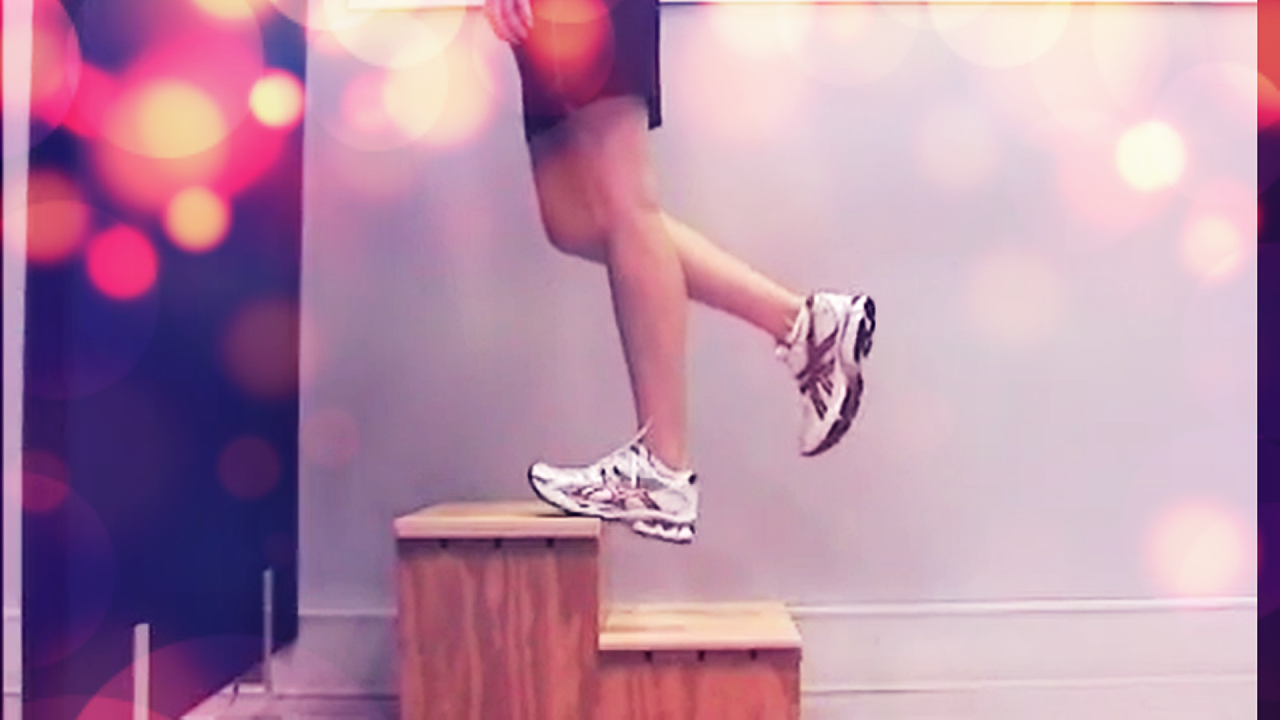
Chronic Achilles tendinopathy is one of the most stubborn overuse injuries a runner can face. Characterized by stiffness, pain, and reduced tendon capacity, it often lingers for months without a structured rehab plan. Fortunately, one of the most effective and accessible treatments is also one of the simplest: the Alfredson Protocol, a daily eccentric calf-loading routine backed by decades of research.
Initially introduced by Alfredson et al. (1998), this method remains popular because it works—and because runners can easily perform it at home with no equipment other than a step and a weighted backpack. This guide explains how the protocol works, how to perform the exercise correctly, and why its simplicity is one of its greatest strengths.
Terminology
Achilles pain has historically been labeled ‘tendinitis’ (inflammation) or ‘tendinosis’ (degeneration). Modern research now uses the umbrella term ‘tendinopathy,’ which describes chronic Achilles symptoms without guessing what the tendon looks like on the inside.
Why Eccentric Calf Training Works
Tendons respond best to progressive mechanical loading. In chronic tendinopathy, the tendon becomes less able to withstand force due to disrupted collagen structure and reduced stiffness. Heavy eccentric loading helps by:
- Stimulating collagen remodeling
- Improving tendon capacity and resilience
- Increasing calf muscle strength
- Reducing pain over time
- Enhancing load tolerance for running and daily activity
Eccentric strengthening of the Achilles tendon serves a dual purpose: it’s great for treating Achilles tendinopathy and also a very effective way to prevent it. If you’re a runner putting in serious weekly miles, using this routine to build calf strength can reduce your risk of this injury.
Can I Keep Running During This Program?
Yes! Running is allowed if:
- Pain during running is mild
- It does not worsen after training
- It does not increase the next morning
Many athletes successfully continue modified training while following this protocol.
The Eccentric Heel-Drop Protocol (Alfredson Method)
Before You Begin
- If you are undergoing treatment by a physician, physiotherapist, or other medical professional, consult them before starting this program.
- Expect muscle soreness (DOMS) during the first 1–2 weeks.
- Running is allowed as long as discomfort is mild and does not worsen during or after the run.
- Consistency is essential—this is a 12-week daily routine, not a short-term fix.
General Guidelines

Step-by-Step Instructions
- Start on the toes of both legs (Fig. 1A).
- Transfer weight to the injured leg and slowly lower the heel below the step.
- Use the healthy, uninjured leg to return to the starting position.
- Continue even if mild pain is present; stop only if pain becomes disabling.
- Please watch the videos below for more information on how to perform the exercises properly.
Frequency
- 2 sessions per day, alternating between the gastrocnemius and soleus protocols
- 7 days per week
- Continue for 12 weeks
Repetitions
- 3 sets of 15 reps for each exercise variation
Exercise Variations
- Straight-leg heel drops (targets the gastrocnemius), see Fig. 1B.
- Bent-knee heel drops (targets the soleus), see Fig. 1C.
Intensity
- Begin the exercise regimen using only body weight.
- Once you can complete the exercises without pain, begin progressive loading with a backpack containing weights (see Fig. 2). Start lightly and increase gradually over several weeks. A slow progression is key—the tendon adapts best when challenged with increasing mechanical load.
- Your goal is to maintain a moderate, tolerable level of discomfort during training.

Helpful Video Demonstrations
These videos by Journal of Foot and Ankle Research (2010) are not from the original Alfredson study but closely follow the same protocol.
Disclaimer
This article is for informational purposes only. It is not medical advice or a substitute for professional diagnosis or treatment. Always consult a healthcare professional regarding injuries or health concerns. Click here to read our complete disclaimer.
_____________
Cover photo courtesy of Journal of Foot and Ankle Research, YouTube screenshot.
References
Journal of Foot and Ankle Research. (2010, Feb 9). Eccentric calf muscle exercises for Achilles tendinopathy Part 1-4. YouTube. (URL of each included video)
Alfredson, H., Pietilä, T., Jonsson, P., & Lorentzon, R. (1998). Heavy-load eccentric calf muscle training for the treatment of chronic Achilles tendinosis. The American journal of sports medicine, 26(3), 360–366. https://doi.org/10.1177/03635465980260030301
Khan, K. M., Cook, J. L., Kannus, P., Maffulli, N., & Bonar, S. F. (2002). Time to abandon the “tendinitis” myth. BMJ (Clinical research ed.), 324(7338), 626–627. https://doi.org/10.1136/bmj.324.7338.626
Scott, A., Squier, K., Alfredson, H., Bahr, R., Cook, J. L., Coombes, B., de Vos, R. J., Fu, S. N., Grimaldi, A., Lewis, J. S., Maffulli, N., Magnusson, S. P., Malliaras, P., Mc Auliffe, S., Oei, E. H. G., Purdam, C. R., Rees, J. D., Rio, E. K., Gravare Silbernagel, K., Speed, C., … Zwerver, J. (2020). ICON 2019: International Scientific Tendinopathy Symposium Consensus: Clinical Terminology. British journal of sports medicine, 54(5), 260–262. https://doi.org/10.1136/bjsports-2019-100885