
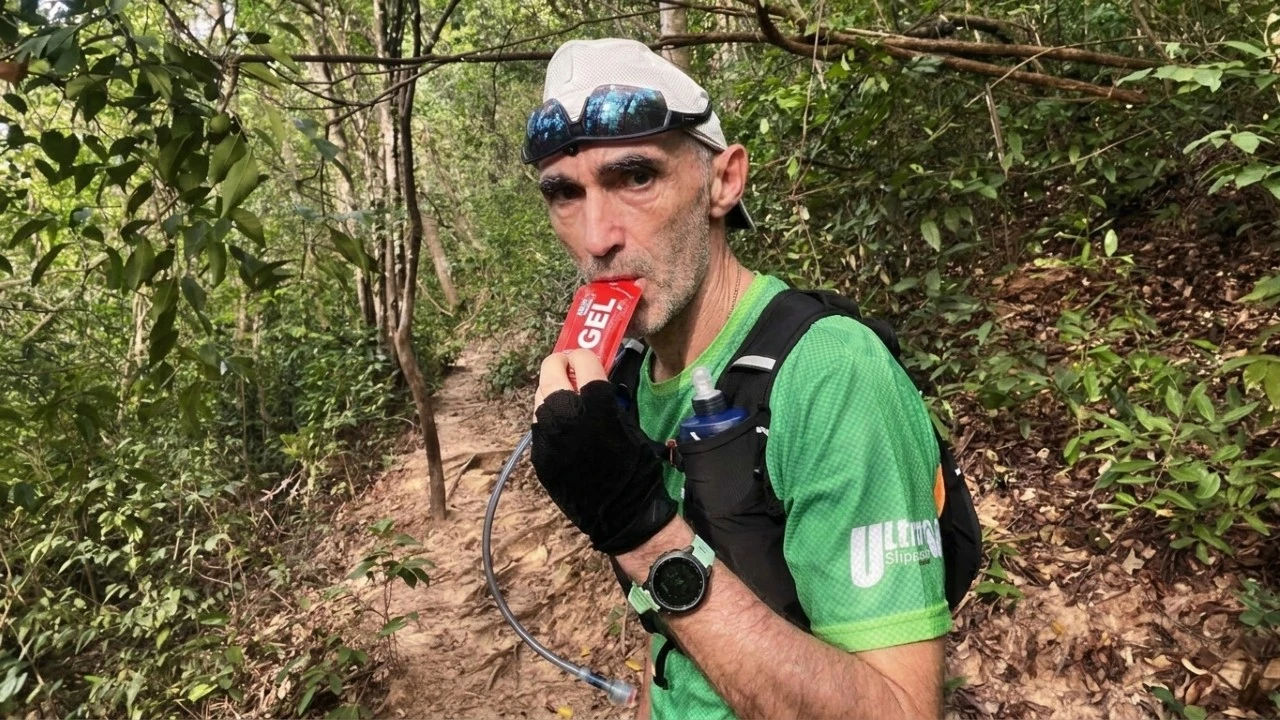
You can carry enough food to fuel an entire ultra and still end up barely eating later in the race. Having fuel available is not the same as being able—or willing—to consume it. Gastrointestinal (GI) problems are a frequent cause of DNFs in ultras, especially in longer races.
That is where gut training comes in.
Preparing your gut for race day requires practicing your fueling strategy, much like training your legs for the physical demands of an ultra. The goal is to establish a sustainable fueling strategy that provides enough energy throughout the race using foods, drinks, and products that you can tolerate.
Gut Training Is More Than Carbohydrates
Carbohydrate intake is a primary focus of gut training because it’s a key fuel during long runs and races. Most direct gut-training research has focused on carbohydrate and fluid feeding, so the evidence for adaptation is strongest there. But building a tolerant gut goes far beyond hitting a specific grams-per-hour carbohydrate target.
Effective gut training requires repeatedly practicing with the full spectrum of fuel and products you intend to use on race day. Volume, concentration, feeding frequency, texture, appetite, thirst, flavor, and the type of food and drink can all matter.
Your everyday diet may matter too. The gut adapts to habitual carbohydrate exposure, so regular carbohydrate intake—not just fueling during training runs—may influence how well you tolerate carbohydrate during exercise.
A fueling plan that looks perfect on paper is useless if you stop wanting to eat—or can’t follow it after hours of racing.
GI Problems Have Many Causes
Stomach problems during an ultra usually have multiple causes. Reduced blood flow to the gut, the physiological stress response, environmental temperature, hydration status, exercise intensity and duration, mechanical jarring, and the amount and type of food or fluid consumed can all contribute.
If GI distress develops during a race, slowing down for a while can reduce the stress on your gut and may help symptoms settle before you gradually resume normal fueling.
Gut training cannot fix every GI problem, but it can help you better tolerate and execute your fueling strategy under exercise stress. You can become more comfortable eating and drinking during races and long training sessions.
How Much Carbohydrate Do You Need?
There’s no magic number that works for everyone. Individual requirements vary with event duration and intensity, body size, fueling opportunities, and tolerance.
For many recreational ultrarunners, somewhere around 60–90 g of carbohydrate per hour is a useful working range. That is not a requirement, and some athletes may need less or more.
Very-high intakes of 100–120 g/h have become fashionable, particularly after reports of elite endurance athletes using them. Some exceptional athletes may genuinely be able to utilize those amounts. More carbohydrate does not automatically mean better performance. So don’t train yourself to tolerate 120 g/h simply because an elite athlete does.
Higher carbohydrate intake should also align with your fluid strategy. Very concentrated carbohydrate intake with too little fluid can increase the risk of GI problems. In practice, take concentrated gels with water unless the product is specifically designed otherwise.
Optimize intake rather than maximize it. Gut training should solve your fueling problem, not create a carbohydrate-eating contest.
Start With What You Can Already Tolerate
No single scientifically established gut-training protocol exists, so you need to experiment and individualize the process.
Start by finding out what you already handle comfortably, then progress from there. Shorter, easy or moderate endurance runs are good starting points for gut training because they let you focus on fueling without also dealing with extreme duration, fatigue, technical terrain, or heat. Increase the fueling challenge gradually as your tolerance improves.
For example, if you currently tolerate 50 g/h and think 75 g/h may be appropriate for your race, you might first move toward 60–70 g/h during easy, manageable sessions. Whenever possible, change one variable at a time rather than increasing carbohydrate intake and run duration at the same time.
Once your target hourly intake feels comfortable, extend the time over which you repeatedly consume it. Then make the sessions more race-specific by adding longer duration, terrain, heat where relevant, accumulated fatigue, and the actual foods and fluids you expect to use on race day.
Start simple, then add specificity.
A practical approach is to begin this process several weeks before your race rather than trying to fix your fueling during your final few long runs. Roughly 6–10 weeks is a practical window to experiment and adjust.

Carbohydrate Type Matters Too
At higher carbohydrate intakes, combining glucose or maltodextrin with fructose allows carbohydrate to be absorbed through more than one intestinal pathway.
The traditional 2:1 glucose-to-fructose ratio is no longer the only approach. Ratios closer to 1:0.8 or 1:1 may support higher carbohydrate delivery, but because individual fructose tolerance varies, test different ratios in training and pay attention to how you feel.
An Ultra Is Not Just Gels
During very long races, your appetite and food preferences can change. After hours of sweet drinks, gels, and chews, you may want something completely different. At the generally lower intensity of longer ultras, some athletes also find solid foods easier to tolerate.
While not every athlete needs options like potatoes or sandwiches, adding flavor and texture variety can help manage taste fatigue and make it easier to keep eating when sweet fueling options become unappealing.
Practice whatever you actually expect to use. If solids will be part of your race plan, eat them in training. The same applies to fluids and drinks.
Gut training should rehearse your full fueling strategy, not just carbohydrate intake.
What About Hydrogels?
Hydrogel carbohydrate products are heavily marketed as a way to consume large amounts of carbohydrate with fewer stomach problems. They may help some athletes, but current evidence does not show they consistently improve GI tolerance or performance compared with conventional carbohydrate products.
Treat them as another option to test—not as a silver bullet for stomach issues.
The Bottom Line
Gut training should be part of your race preparation, rather than a fueling decision you make in race week.
Start with what you already tolerate. Decide what your event likely requires. Gradually increase the fueling challenge, then practice the strategy during longer and more race-specific sessions.
Test your carbohydrate amount, carbohydrate mixture, drinks, gels, solid foods, timing, and feeding frequency before race day.
The goal isn’t to consume as much carbohydrate as possible. The goal is to build a fueling strategy that delivers the energy you need and that you can sustain all the way to the finish.
_____________
Cover image by the author, featuring the author.
References
The following references provide scientific context for the concepts discussed above.
Costa, R. J. S., Gaskell, S. K., Henningsen, K., Jeacocke, N. A., Martinez, I. G., Mika, A., Scheer, V., Scrivin, R., Snipe, R. M. J., Wallett, A. M., & Young, P. (2025). Sports Dietitians Australia and Ultra Sports Science Foundation joint position statement: A practitioner guide to the prevention and management of exercise-associated gastrointestinal perturbations and symptoms. Sports Medicine, 55, 1097–1134. https://doi.org/10.1007/s40279-025-02186-6
Costa, R. J. S., Miall, A., Khoo, A., Rauch, C., Snipe, R., Camões-Costa, V., & Gibson, P. R. (2017). Gut-training: The impact of two weeks repetitive gut-challenge during exercise on gastrointestinal status, glucose availability, fuel kinetics, and running performance. Applied Physiology, Nutrition, and Metabolism, 42(5), 547–557. https://doi.org/10.1139/apnm-2016-0453
Jeukendrup, A. E. (2017). Training the gut for athletes. Sports Science Exchange, 30(178), 1–5. https://www.gssiweb.org/sports-science-exchange/article/training-the-gut-for-athletes
Li, P., Song, Q., & Xu, N. (2026). Plant-derived alginate polysaccharide hydrogels in sport and exercise nutrition: Implications for carbohydrate metabolism, gastrointestinal integrity, exercise recovery, and athletic performance. Frontiers in Nutrition, 13, 1774380. https://doi.org/10.3389/fnut.2026.1774380
Martinez, I. G., Mika, A. S., Biesiekierski, J. R., & Costa, R. J. S. (2023). The effect of gut-training and feeding-challenge on markers of gastrointestinal status in response to endurance exercise: A systematic literature review. Sports Medicine, 53, 1175–1200. https://doi.org/10.1007/s40279-023-01841-0
Plews, D. J., Booth, P. D., Krieger, T., & Maunder, E. (2026). Fuelled or fooled? Examining the evidence and mechanisms behind ultra-high carbohydrate intake in endurance athletes. Sports Medicine. Advance online publication. https://doi.org/10.1007/s40279-026-02462-z
Tiller, N. B., Roberts, J. D., Beasley, L., Chapman, S., Pinto, J. M., Smith, L., Wiffin, M., Russell, M., Sparks, S. A., Duckworth, L., O’Hara, J., Sutton, L., Antonio, J., Willoughby, D. S., Tarpey, M. D., Smith-Ryan, A. E., Ormsbee, M. J., Astorino, T. A., Kreider, R. B., … Bannock, L. (2019). International Society of Sports Nutrition position stand: Nutritional considerations for single-stage ultra-marathon training and racing. Journal of the International Society of Sports Nutrition, 16, 50. https://doi.org/10.1186/s12970-019-0312-9