
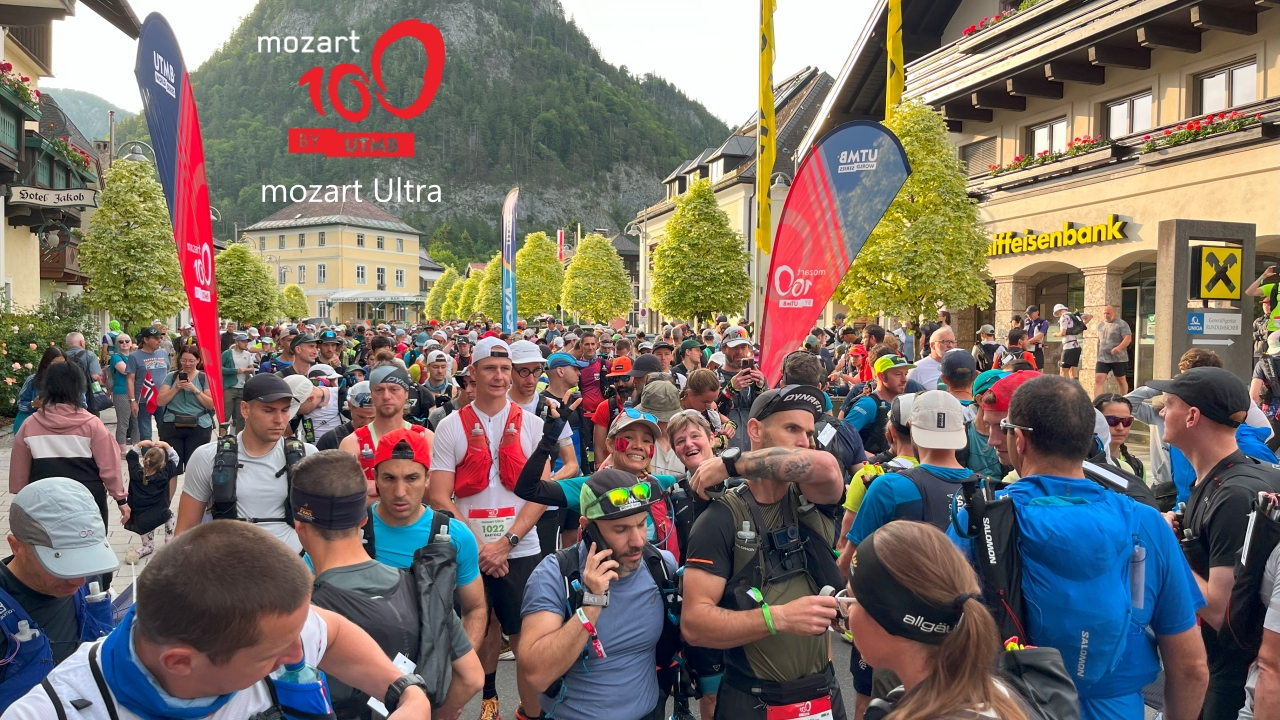
Success in an ultra-trail race like the Mozart Ultra isn’t just about fitness—it takes smart preparation, a focused mind, and the willingness to put in the work. Here’s how she pulled it off at age 50: from her training strategy and strength work, to fueling, recovery, and what kept her going when things got tough. It’s a story of tenacity and resilience, planning, and the kind of quiet confidence that comes from effective training and years of experience.
The Race
The Mozart Ultra is a brutal 92 km (57 mi) trail race in the Austrian mountains, with 4,700 m (15,420 ft) of elevation change. It is part of the Mozart 100 by UTMB® series, featuring six distances ranging from 9 km (5.5 mi) to 120 km (75 mi). The races take place in Salzburg, Austria, in early June each year.
Defying Limits at 50
When Sutinee Rasp (Nee) crossed the finish line after 15 hours and 25 minutes, she wasn’t just ticking off another race—she was proving something powerful: age doesn’t have to stop you from setting new athletic goals. With thousands of meters of elevation change, steep technical descents, and long hours on her feet, she stayed strong, steady, and focused from start to finish.
Athlete Background
Nee, 50, has spent the last decade building a solid foundation in trail running. Before that, she was already a force on the road, starting with marathons and half-marathons that helped develop endurance and speed. But it was on the trails where she truly found her stride. Over the years, she’s consistently landed on overall podiums and maintained a national top 10 ranking with the International Trail Running AssociationThe International Trail Running Association (ITRA) represents all parties involved in trail running (i.e., runners and race organizers)…. More (ITRAThe International Trail Running Association (ITRA) represents all parties involved in trail running (i.e., runners and race organizers)…. More). She typically competes in trail races ranging from 40 km (25 mi) to 70 km (44 mi), with two 100 km (62 mi) events in her legs before the COVID lockdowns.

While younger runners have recently started to push the pace and shift the competitive landscape, Nee remains a powerhouse, currently ranked in the national top 15. All of this while holding down a full-time job, often including weekends. She’s not a professional athlete, just exceptionally talented and committed.
We knew the Mozart Ultra, being a qualifier for UTMB Worlds, would draw some serious competition. A podium finish for Nee seemed like a long shot, but we were confident she could still pull off a really strong showing.
Race Requirements
Before anything else, we thoroughly analyzed the specific demands of the Mozart Ultra, looking at distance, elevation profile, elevation change per kilometer, and everything else unique to this course. Based on that, we came up with a plan suitable for Nee’s age, a plan focused on building race-specific fitness while avoiding injury or overtraining.

The Training
We started preparing for the Mozart Ultra in early January 2025, about 5 months before race day. The early phase centered on building fitness through non-specific, general work—tempo runs, steady-state efforts, and high-end aerobic sharpening through local 10K races and half-marathons. After years of high-volume training and frequent racing, Nee already had a strong aerobic base.
Since we live in pancake-flat Bangkok, hill work needed some creativity. The treadmill became our best training partner, with regular steep hiking and hill repeat sessions. Whenever possible, we took day trips to hillier areas to get real terrain under our feet.
As we moved closer to race day, the training became more Mozart Ultra-specific. Key workouts were no longer just about effort but focused more on time on feet, elevation change, and fatigue management.

Here is a list of four crucial efforts of Nee’s race preparation, each building on the one before:
- A 60 km (37.3 mi) road ultra that gave us a chance to sharpen durabilityDurability refers to the time course and magnitude of deterioration in an athlete’s physiological, mechanical, and performance-related characteristics… More and test our nutrition.—Nee finished 2nd woman overall in the Bang Phra 60 km race.
- Two three-day training camps where we stacked volume and mimicked the elevation profile of the race as closely as possible.—In his book, How to Succeed at UTMB®, Guillaume Millet calls this very effective approach “Weekend ShocksA shock weekend is a training method that simulates the conditions of an ultratrail race in terms of… More.”—Read about our first training camp here.
- A 12-hour hill repeat competition served as a final mental and physical tune-up two weeks before race day. The competition included serious downhill running, excellently preparing her legs for the downhills on race day.—Nee secured 1st woman overall, completing the most reps.—Read the story of her final prep here.
Strength Training & Mobility Work
At this stage in her running career and life, we consider strength training essential. During the early training phases, she lifted weights twice weekly, focusing on heavy compound movements with low rep counts. Typically, this included 2 or 3 sets of 5 to 7 reps of deadlifts, low-bar back squats, occasional hip thrusts for additional glute strength, and some upper-body exercises.
As race day approached, we reduced her strength training to once a week, still maintaining a heavy load but limiting it to just one solid set of 5 to 7 reps. This approach allowed her to preserve maximal strength and neuromuscular function without introducing unnecessary fatigue during peak running volume.
Knowing that trail running is a full-body activity, we included regular mobility work targeting the entire body. Thanks, ECFit / Erin Carson, for your Monday Mobility sessions!
Nutrition & Fueling
It’s no secret that Nee loves to eat. She maintains a well-balanced, whole-food diet with a good mix of macronutrients. There was no need for any changes. We made sure that every training session was properly fueled and hydrated, especially the longer efforts where energy availability was critical. After demanding workouts, we added protein shakes to help with muscle repair and recovery. No strict rules or special diets, just smart and timely fueling and lots of downtime that kept her strong throughout the entire training period.
Race Day
Race day went really well! Nee was amazing, setting a consistent pace and running all the runnable sections from start to finish. It highlighted how prepared and tough she was.
I crewed her at four key aid stations, which allowed us to check in regularly. For most of the day, weather conditions were nearly perfect for running, with overcast skies and temperatures below 20°C (68°F). Just before she arrived at the last crewed aid station at Koppl, the rain started—and it didn’t stop until the finish.
The final 17 to 18 kilometers (10.6 to 11.2 miles) turned into a muddy, slippery challenge, making it the toughest part of the day for Nee. It was no longer fun. It became gritty, determined work. Still, Nee never hit a wall. She stayed focused and upbeat, kept moving steadily, and never considered quitting. Based on how she was moving, I felt sure she’d finish under 16 hours—and she did.

Final Thoughts
There are several ways to prepare for a race like the Mozart Ultra. You’ll want to pick the option that best fits your situation and abilities. With Nee, we didn’t try to force a rigid structure—we let the training flow and made sure there was adequate recovery between efforts. We made strategic use of races that happened to fall within the buildup, and we packed a lot of volume and elevation training into two multi-day camps to mimic race demands closely.
Nee’s focused and disciplined work over the months paid off. She trained intentionally, listened to her body and her coach (her husband, Gregor Rasp), and we made adjustments when life—or age—required it. This approach led to a finish that exceeded expectations, allowing everyone to have an early night.
At 50, she continues to evolve as an athlete, proving that age is no barrier when experience, motivation, and preparation come together. She arrived at the starting line both physically and mentally ready. She trusted her training and ran a race that showcased her experience, toughness, and passion for the sport.
_____________
Cover photo by Gregor RaspGregor Rasp, CSCS and UESCA-certified ultrarunning coach, is the founder of Top Of The Trail, specializing in trail… More – The scene at the start line of the Mozart Ultra, minutes before the gun went off at Fuschl am See.